
Why Some Homes Feel Better Than Others: The Science Behind Thoughtful Interior Design
.png)
Have you ever walked into a home and immediately felt comfortable?
Perhaps you couldn't identify exactly why. The room simply felt balanced, welcoming and easy to be in.
Then there are other spaces that may be beautifully furnished, yet somehow feel uncomfortable, overly busy or lacking in warmth.
There is more behind these reactions than personal taste alone.
A growing body of research across environmental psychology, architecture and health explores the relationship between our surroundings and the way we feel and function. Natural light can influence our circadian rhythms. Noise can affect sleep, concentration and wellbeing. Connections with nature have been associated with stress recovery, while even our experience of art can influence how we feel.
At Amanda Cullity Interiors, this reinforces a question that sits at the heart of our design process:
How do you want your home to make you feel?
Because thoughtful interior design isn't simply about creating a home that looks beautiful.
It's about creating one that feels beautiful to live in.
Our Surroundings Affect Us More Than We Realise
We spend an enormous amount of our lives indoors, so it makes sense that our surroundings have an impact on us.
Environmental psychology examines the relationship between people and the environments they inhabit. Research in this area has explored everything from natural light and noise to views, spatial organisation and our connection with nature.
The relationship isn't always simple. There is no single colour, material or furniture arrangement guaranteed to make everyone feel the same way.
But the research does give us valuable clues about the characteristics of environments that can support comfort and wellbeing.
For interior designers, the challenge is to translate those principles into homes that also respond to the architecture, surroundings, personality and lifestyle of the people who live there.
Natural Light Does Far More Than Illuminate a Room
Natural light is one of the most powerful elements in an interior.
We tend to think about daylight in visual terms: a sunny room looks brighter, colours appear more vibrant and the connection between inside and outside becomes stronger.
But light also has biological effects.
Our bodies operate according to approximately 24-hour circadian rhythms that help regulate sleep and wakefulness. Research into daylight and buildings has found that the light entering through windows can play an important role in supporting these rhythms.
This gives window design and window treatments an interesting dual role.
We want to make the most of natural light, but in Perth we also need to consider glare, privacy and the intensity of our sunlight.
Sheer curtains can soften strong daylight without completely disconnecting us from the outdoors. Blinds can provide greater control when needed. The right window treatment can transform not only how a room looks, but how comfortable it feels throughout the day.
Good interior design doesn't simply ask:
"What curtains would look beautiful here?"
It also asks:
"What is the light doing in this room, and how do we want to experience it?"
Why We Feel Better Around Nature
Most of us don't need scientific research to tell us that being in nature can feel restorative.
We experience it ourselves.
A walk through a leafy park, sitting beside water or looking across a garden can give us a sense of distance from the demands of everyday life.
Biophilic design explores how some of that connection with the natural world can be incorporated into the built environment.
Recent research reviews—particularly in healthcare settings, where this subject has been studied extensively—have associated features such as green views, plants, natural materials and daylight with outcomes including stress recovery and emotional wellbeing. Researchers also caution that evidence varies between interventions and that more long-term research is needed.
For the home, biophilic design doesn't mean filling every room with indoor plants.
Sometimes the most powerful natural feature is already there.
A beautiful tree outside a window.
Morning light entering a bedroom.
A view towards a garden.
Timber with a visible grain.
Natural stone.
Linen, wool and other natural fibres.
Thoughtful interior design can celebrate these elements rather than compete with them.
Sometimes the Best Artwork Is Outside the Window
This is something I find particularly interesting as an interior designer.
If a home has a wonderful outlook, the view itself can become part of the interior.
Furniture placement can preserve sightlines. Window treatments can frame rather than obscure a garden. Interior colours and materials can complement what is happening outside.
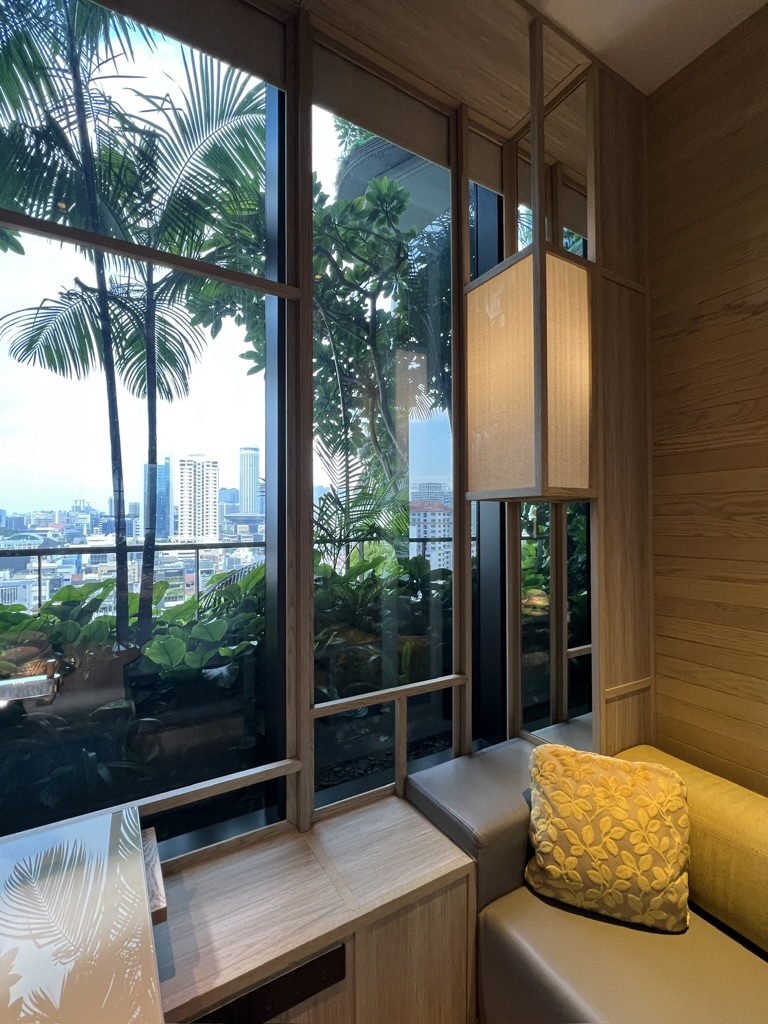
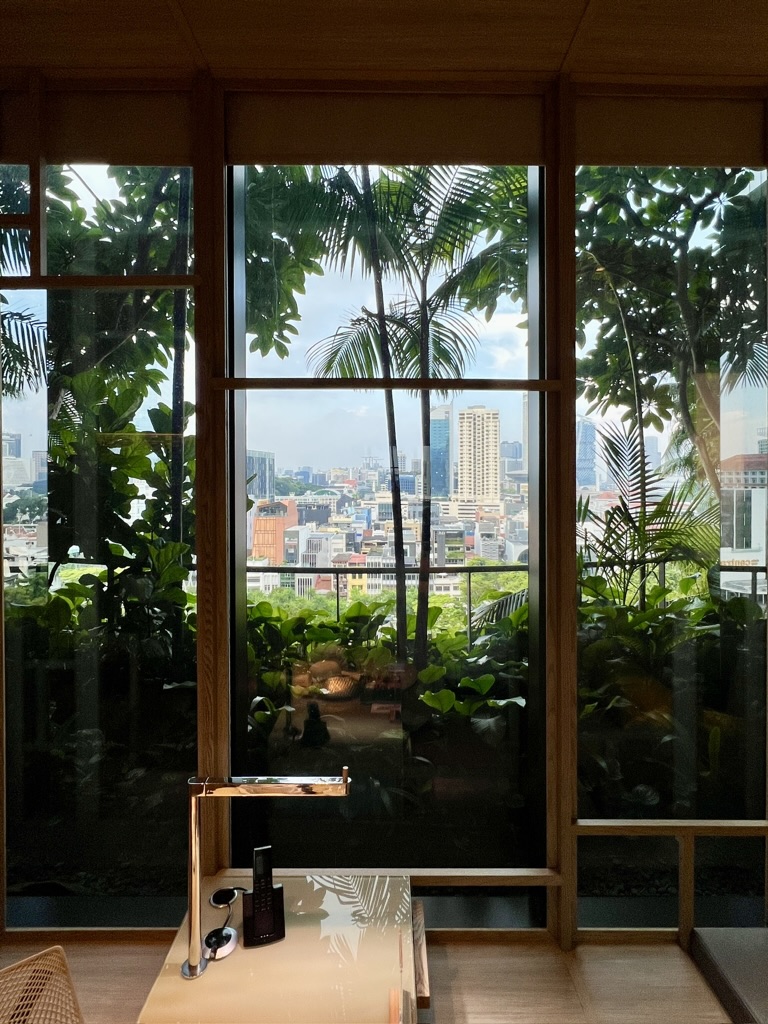
A stunning example of biophilic interior design is inside the PARKROYAL Pickering hotel in Singapore, where abundant planting outside the hotel windows becomes an important decorative element within the rooms, frames the view of the urban environment outside and has a grounding effect even though the rooms are sky high.
The interior doesn't need to compete for attention.
Nature is allowed to take centre stage.
The same principle can be applied beautifully to Perth homes, particularly where there is an established garden, mature trees, a courtyard, parkland or even a carefully framed glimpse of greenery.
Visual Calm Doesn't Have to Mean Minimalism
One misconception I would particularly like to challenge is that a calm interior needs to be minimalist.
It doesn't.
A home can contain books, artwork, photographs, collected objects, patterned textiles and treasured furniture and still feel beautifully balanced.
The difference is often visual organisation.
When too many unrelated objects compete for attention, a room can feel unsettled. When belongings have been thoughtfully edited, grouped and given appropriate places, the same home can feel layered and personal without feeling chaotic.
This is where feature cabinetry can be particularly valuable.
Beautiful cabinetry allows us to choose what we want to display and what we would rather put away. A collection can be celebrated rather than scattered. Books can become part of the character of the room. Everyday necessities can disappear behind doors.
Thoughtful design isn't necessarily about having less.
It's about creating greater clarity around what you choose to live with.
Why Floor Rugs Make Rooms Feel More Settled
There is a visual reason a correctly sized floor rug can transform a room.
It collects the furniture.
Without a rug—or with one that is too small—a sofa, occasional chairs and tables can appear to float independently within a large space.
A generously proportioned rug creates a visual boundary around the furniture and helps the individual pieces read as one composition.
But rugs and other soft furnishings also influence something we don't always think about when decorating:
sound.
Hard surfaces reflect sound. Softer materials absorb some of it.
Rugs, upholstered furniture and curtains can therefore contribute to the acoustic character of a room. This can be particularly important in contemporary open-plan homes containing large areas of glass, hard flooring and high ceilings.
The broader health evidence around excessive environmental noise is substantial: the World Health Organization identifies noise as an environmental risk that can interfere with sleep, cognition and everyday wellbeing.
A floor rug won't solve serious environmental noise problems, of course. But at the scale of an interior, thinking about acoustics alongside aesthetics can help create rooms that are more comfortable for conversation and everyday living.
Why Texture Matters
We don't experience our homes only through our eyes.
We touch them.
We feel the cool surface of stone, the warmth and grain of timber, the softness of linen and the texture of a wool rug beneath our feet.
This is one of the reasons I love working with natural materials.
They introduce subtle variation and imperfection. Timber grain changes from one board to another. Natural stone contains markings that have developed over geological time. Linen has movement and texture that a perfectly uniform synthetic surface may not.
These qualities give interiors depth.
They also help explain why a room composed entirely of hard, smooth, highly uniform surfaces can sometimes feel less inviting than one in which different textures have been thoughtfully layered.
The goal isn't to add texture everywhere.
As with so many elements of good interior design, it's about balance.
Lighting Changes How We Experience the Same Room
A beautifully designed room shouldn't work at only one time of day.
During daylight hours, natural light might be the dominant source.
By evening, the atmosphere changes completely.
This is why layered lighting is so important.
Rather than expecting ceiling lights to do everything, we can use different sources for different purposes: a floor lamp beside an armchair, a table lamp on a console, task lighting where it is needed and accent lighting to illuminate an artwork or feature cabinet.
The result is flexibility.
A living room can be practical when needed, intimate when entertaining and restorative at the end of the evening.
Thoughtful lighting design recognises that our homes aren't static compositions.
We experience them over time.
Original Artwork and the Human Touch
There is something special about living with original artwork.
In an era when almost anything can be mass-produced, copied or digitally reproduced, an original work carries evidence of another person's creativity.
The brushstrokes are real. The decisions made by the artist are visible. No other piece is exactly the same.
Emerging research into viewing visual art is particularly interesting. A recent study found that viewing art in a museum setting was associated with greater subjective wellbeing and lower reported stress, although the researchers did not find corresponding differences in heart rate or cortisol and therefore cautioned against overstating physical-health effects.
Even newer research has begun comparing people's physiological responses to viewing original paintings in galleries with viewing reproductions in laboratory settings. The findings are intriguing, although this remains an emerging field and shouldn't be interpreted as proof that simply hanging an original painting in your living room will improve your health.
For me, the value of original artwork in the home is also more personal.
You choose a work because something about it speaks to you.
Perhaps it reminds you of a landscape.
Perhaps you love the colours.
Perhaps you met the artist.
Perhaps you simply can't stop looking at it.
Over time, the artwork becomes part of the story of your home.
I particularly enjoy introducing clients to original works by Western Australian artists. Apart from supporting local creativity, these pieces bring an authenticity and sense of place that feels increasingly valuable in an era of mass production.
A Home Should Reflect Its Architecture—and Its Owners
Science can give us useful principles, but it can't design a home for us.
Two people can respond quite differently to the same colour, artwork or environment.
This is why I don't believe in imposing a particular design style on every client.
At Amanda Cullity Interiors, we take design cues from the existing architecture—the proportions of the rooms, natural light, outlook, materials and relationship with the surrounding landscape.
Then we consider the people.
How do you live?
How do you entertain?
What do you already own and love?
What would you like to keep?
What isn't working?
And, importantly:
How do you want your home to make you feel?
The design develops where those two things meet: the character of the home and the character of the people living in it.
Good Interior Design Can Make Everyday Life Feel Easier
Some of the most valuable design decisions are almost invisible once they're resolved.
The sofa is the right size, so circulation feels natural.
The rug is large enough to collect the furniture.
The window treatments provide privacy without unnecessarily sacrificing daylight.
The lighting changes with the way the room is being used.
The feature cabinet provides somewhere for clutter to disappear while giving treasured objects room to breathe.
The artwork has the right scale for the wall.
Individually, these decisions can seem small.
Together, they change the experience of living in the home.
And they remove something many of my clients struggle with before they come to me:
decision fatigue.
Instead of making dozens of isolated choices about furniture, lighting, colours, rugs and window treatments, we create one cohesive design vision.
Every subsequent decision has something to relate back to.
Seeing How Your Home Will Feel Before Making the Changes
One of the most valuable developments in my own design process has been photorealistic 3D visualisation.
Interior design asks clients to make significant decisions about things that don't yet exist together.
A fabric sample may be beautiful.
A floor rug may be beautiful.
An occasional chair may be beautiful.
An artwork may be beautiful.
But will they be beautiful together, in your room?
Photorealistic 3D imagery allows us to explore that question before purchases are made.
Clients can see proportion, furniture placement, colour relationships, feature cabinetry, artwork and lighting within a representation of their own home.
It turns an abstract concept into something much easier to understand.
For many clients, this is the moment the design truly comes to life.
Thoughtful Interior Design Is About Better Living
Perhaps the most important lesson from the research into our environments is that good design shouldn't be judged only by appearance.
Our homes are where everyday life happens.
We wake up in them.
Work in them.
Rest in them.
Entertain friends in them.
Share meals in them.
And retreat to them when the outside world becomes busy.
It follows that the way our homes feel deserves just as much consideration as the way they look.
Thoughtful interior design brings together architecture, light, nature, colour, texture, sound, furniture, artwork and the individual needs of the people who live there.
Not every beautiful home needs to be minimalist.
Not every client wants the same aesthetic.
And not every room should make us feel the same way.
The goal is to understand how you want to live and how you want to feel, then make considered design decisions that support that experience.
Because ultimately, a successful interior doesn't just photograph beautifully.
It feels right when you live in it.
Frequently Asked Questions About Interior Design and Wellbeing
Can interior design really affect how you feel?
Our physical environment can influence comfort, mood, sleep, concentration and stress, although these relationships are complex and vary between individuals. Research has particularly examined factors such as daylight, noise, connections with nature and environmental quality. Thoughtful interior design considers these alongside aesthetics and function.
What is environmental psychology in interior design?
Environmental psychology studies the relationship between people and their physical surroundings. In interior design, its principles can help us think more deeply about how light, sound, spatial organisation, nature, privacy and other environmental qualities affect the experience of a room.
What makes a home feel calm?
There isn't one universal formula. For many people, a sense of visual order, comfortable lighting, appropriate acoustics, connection with nature, considered furniture placement and meaningful personal objects can contribute to a more settled environment. A calm home doesn't necessarily need to be minimalist.
Does natural light affect wellbeing?
Light has both visual and non-visual effects. Research has established an important relationship between light exposure and our circadian system, which helps regulate sleep and wakefulness. Thoughtful window treatments can help balance access to daylight with glare, heat and privacy.
What is biophilic interior design?
Biophilic interior design seeks to strengthen our connection with nature within the built environment. This can include natural light, indoor plants, natural materials, garden views and other connections to the outdoors. Research into biophilic environments has reported promising wellbeing effects, although outcomes and the strength of evidence vary across settings.
Do rugs and curtains improve acoustics?
Soft furnishings can absorb some reflected sound and help reduce the hard, reverberant character of a room. Floor rugs, curtains and upholstered furniture can therefore form part of a more acoustically comfortable interior, particularly in open-plan homes with extensive hard surfaces.
Why does original artwork make a home feel different?
Original artwork introduces individuality, human creativity and personal meaning into a home. Research into the psychological effects of viewing art is developing, with recent studies reporting associations with subjective wellbeing and stress, although the evidence shouldn't be interpreted as showing that artwork alone produces specific health outcomes.
How can I make my home feel less cluttered without becoming minimalist?
Start by considering what you genuinely want to see and use. Feature cabinetry can conceal everyday items while providing dedicated spaces for books, collections and meaningful objects. Appropriate furniture scale, fewer competing focal points and thoughtful editing can create visual clarity without removing the personality from your home.
Can an interior designer help if I want to manage my own home makeover?
Yes. Many Amanda Cullity Interiors clients coordinate their own home makeovers. We provide a cohesive design direction supported by concept designs, product selections, design boards, space plans, product lists and photorealistic 3D visualisations, giving you a clear roadmap to implement at your own pace.
How can Amanda Cullity Interiors help?
Amanda Cullity Interiors offers personalised interior design services for Perth homeowners, including initial consultations, colour consultations, concept designs, furniture and feature lighting selections, window treatments, floor rugs, feature cabinet design, soft furnishings, original artwork recommendations, product selections, design boards, space plans, product lists and photorealistic 3D visualisations.
Our approach considers both the architecture of your home and the way you want to live and feel within it, bringing individual decisions together into a thoughtful, cohesive design vision.
Further Reading & Research
This article draws on research from environmental psychology, biophilic design, circadian science, acoustics and the emerging study of art and wellbeing. For readers interested in exploring the science behind these ideas further, the following research provides useful background:
Natural Light & Circadian Health
Ghaeili Ardabili, N., Wang, J. & Wang, N. (2023). A systematic literature review: Building window's influence on indoor circadian health. Renewable and Sustainable Energy Reviews, 188, 113796.
https://pubmed.ncbi.nlm.nih.gov/37927424/
Biophilic Design & Wellbeing
Tekin, B.H. et al. (2022). A Systematic Review and Conceptual Framework of Biophilic Design Parameters in Clinical Environments.
https://pmc.ncbi.nlm.nih.gov/articles/PMC9755679/
Environmental Noise & Wellbeing
World Health Organization. Guidance on Environmental Noise.
https://www.who.int/tools/compendium-on-health-and-environment/environmental-noise/
Art, Stress & Wellbeing
Evidence for the effects of viewing visual artworks on stress outcomes: A scoping review (2021).
https://pmc.ncbi.nlm.nih.gov/articles/PMC8246362/
Research into the relationship between our environments and wellbeing continues to evolve. The studies referenced here provide scientific context for the design principles discussed in this article; they should not be interpreted as suggesting that individual interior design choices produce specific health outcomes.
.png)